
What Probate Covers in Mason County
Probate is the court process for handling what a person owns and who they were responsible for. The Mason County Probate Court hears the admission of wills, the administration of estates, and the supervision of trusts. It also weighs guardianships and conservatorships for minors and for adults who are incapacitated, protected, or developmentally disabled. Commitment and course-of-treatment matters for people with a mental illness run through the same court. These are sensitive cases, and the file for each one becomes a probate record.
Michigan runs 83 counties, and each keeps its own probate court except for ten northern counties that share five probate districts. Mason County has its own bench. One judge serves the court, and that judge also holds concurrent jurisdiction in the family division of the circuit court. That overlap means an estate, a minor guardianship, and a related family case can all be heard by the same person. The court sits inside the Historical Mason County Courthouse in downtown Ludington, alongside the 51st Circuit Court and the 79th District Court.
Estate records are the most common request. They open when someone dies and property must pass to heirs or be used to pay debts. A will names who inherits and who manages the estate, and the court confirms that the document is valid before it takes effect.
Mason County Probate Terms Defined
Probate filings carry words that rarely come up in daily life. A quick reference clears up the ones that appear most often in a Mason County estate or guardianship case. Each term below points to a role or a status the court records track.
- Testator
- The person who makes a valid will that directs how their property passes at death.
- Executor
- The person named in a will to gather assets, pay debts, and distribute property. Michigan often calls this role the personal representative.
- Intestate
- Dying without a valid will, which leaves state law to decide who inherits the estate.
- Guardianship
- A court arrangement that places the personal care of a minor or an incapacitated adult under a guardian.
- Conservatorship
- A court arrangement that gives a conservator control over the money and property of a protected person.
These roles show up throughout a case file. A record may name a testator, an executor, a guardian, and a ward all in the same matter, so knowing the labels helps a searcher read the docket.
How to Search Mason County Probate Records
Public probate searching runs through MiCOURT Case Search, Michigan's statewide case system. The county does not host its own probate database. Instead, the Mason County Probate Court page links to a court-specific route, listed as P53, that opens the search set to Mason County probate cases. The county's own page for the court explains the workflow, the judge, and the public hours in one place. You can review the Mason County Probate Court page before starting, then follow the link out to the search tool.
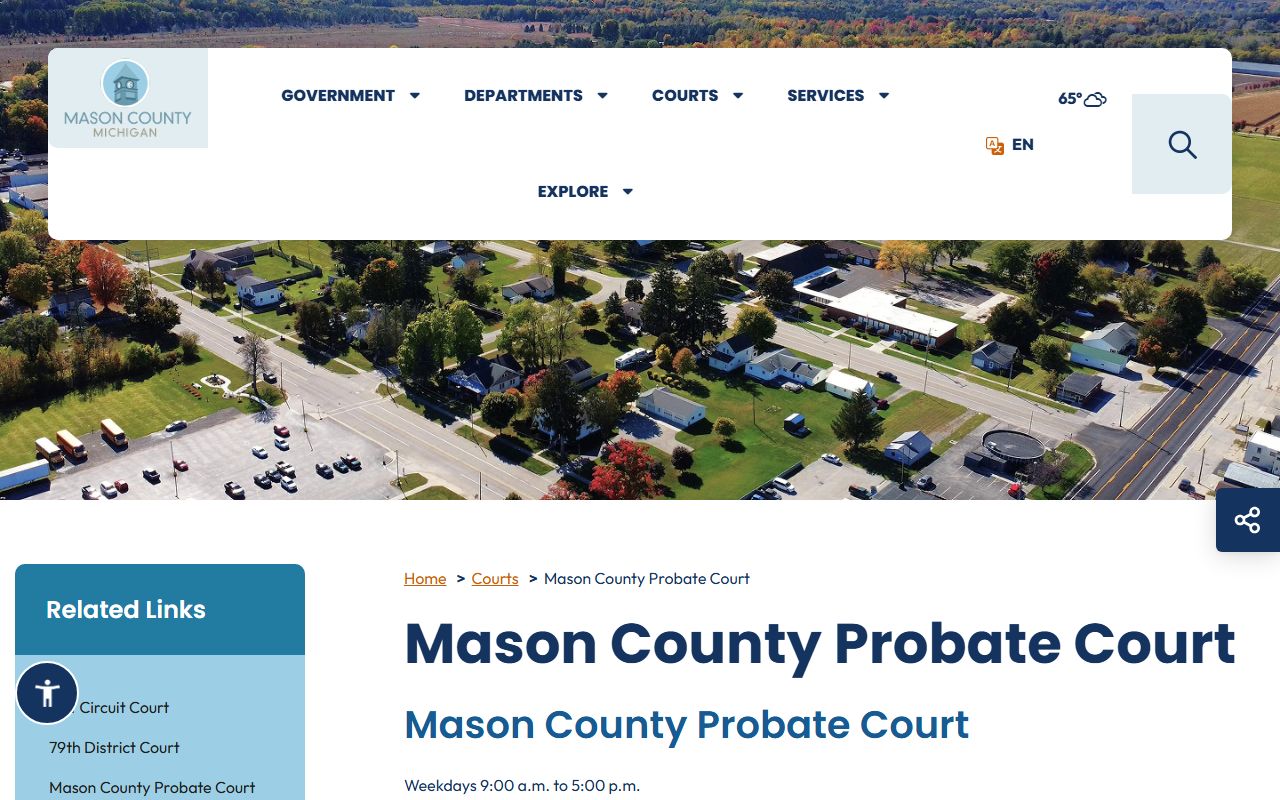
That page hands the searcher off to the Michigan Courts One Court of Justice system, run by Judicial Information Services. From there the steps are short and repeatable. The order below follows the process the county describes for reaching a register of actions.
- Open the MiCOURT probate search route for Mason County, which preselects the local probate court.
- Read the terms of service, then complete the "I'm not a robot" images until a green arrow appears and click continue.
- Enter the name of a party or a known file number, then submit the search.
- Scroll the results and click a file number to open that case's register of actions.
- Apply limiting filters to narrow a broad result set, and expand or collapse case-file detail sections as needed.
- Use the print link at the top right to save a copy, and the breadcrumb links at the top left to return to results or begin a new search.
The register of actions is the chronological list of filings and events tied to a case. It is the online heart of a probate lookup. Michigan and federal law block certain nonpublic details, so the tool never shows everything in the paper file. The county also warns that online public information does not replace the official record kept by the court.
Note: MiCOURT is free and needs no account, but it is a public information tool only and will not stand in for a certified copy in a legal proceeding.
Mason County Probate Search Fields
The MiCOURT probate search asks for only a few inputs, and most of them are optional paths to the same result. A party name works when you know who is involved, and a file number works when you already have the case. The table gathers the fields the county describes so a searcher knows what to expect before the terms screen loads.
| Field / Control | Required | Notes |
|---|---|---|
| Court | Yes | The route preselects Mason County Probate Court under P53. |
| Terms of service and captcha | Yes | Accept the terms and clear the "I'm not a robot" images before searching. |
| Party name | Optional search path | Used for estate, guardianship, and other probate party searches. |
| File number | Optional search path | Used when the case number is already known. |
| Limiting filters | Optional | Filters narrow a set of retrieved results. |
| Submit | Yes | Runs the search against the probate index. |
| Optional | Available on a case detail or register-of-actions view. |
A name search casts a wider net and is the better starting point for genealogy or heir research. A file-number search jumps straight to one case. Either path lands on the same register of actions once a result is opened.
Mason County Probate Court
The county has one probate court, and it operates from the historic courthouse in Ludington. The Hon. Jeffrey C. Nellis serves as Chief Judge. For official copies, older records, or any matter that is not visible online, the court office is the right destination. Probate keeps its own public hours, and they differ from the rest of the building, so it helps to plan around the midday closure.
Mason County Probate Court
Hon. Jeffrey C. Nellis, Chief Judge
304 East Ludington Avenue
Ludington, MI 49431-2121
231-843-8666
Weekdays 9:00 a.m. to 5:00 p.m., closed noon to 1:00 p.m.
Call ahead for a records request if the case is old or the file is thick. Staff can confirm whether a document is public, what a certified copy of a probate order involves, and whether the record exists in paper or in the electronic system. Marriage and divorce files sit with a different office, so those requests route to the county clerk rather than the probate counter. The county's Mason County marriage and divorce records resources cover that path.
Small Estate Options in Michigan
Not every estate needs full probate. Michigan's Estates and Protected Individuals Code, known as EPIC, offers simplified tools when an estate is small and meets the statutory limits. These paths save time and cost when there is little property to pass. Mason County processes them through the same probate court, but the paperwork is lighter than a supervised administration.
The first tool is an assignment of a small estate. It lets the court assign a modest estate to a surviving spouse or heirs after funeral and burial costs are paid. The statute sets the threshold and the procedure. You can read the governing law on the Michigan small-estate assignment statute page at MCL 700.3982, which lays out how the assignment works.
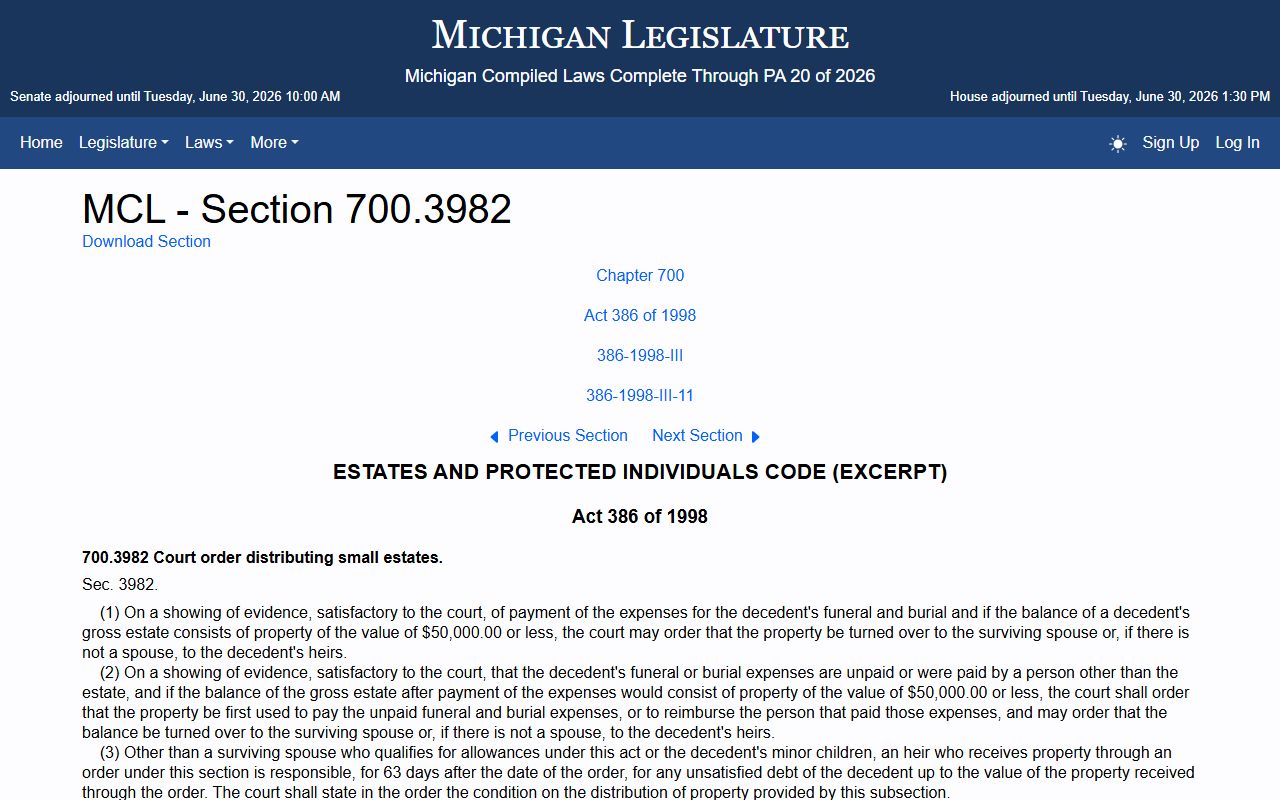
That statute is the authority a Mason County petitioner relies on for the assignment route. It explains the dollar limit and the order in which costs and heirs are paid. Reading it first helps a family decide whether the simplified path fits before they file anything.
The second tool skips court supervision for certain property. A transfer by affidavit lets a successor collect small-estate personal property without a full probate case once a waiting period passes and the estate stays under the limit. The rules appear on the Michigan transfer-by-affidavit statute page at MCL 700.3983.
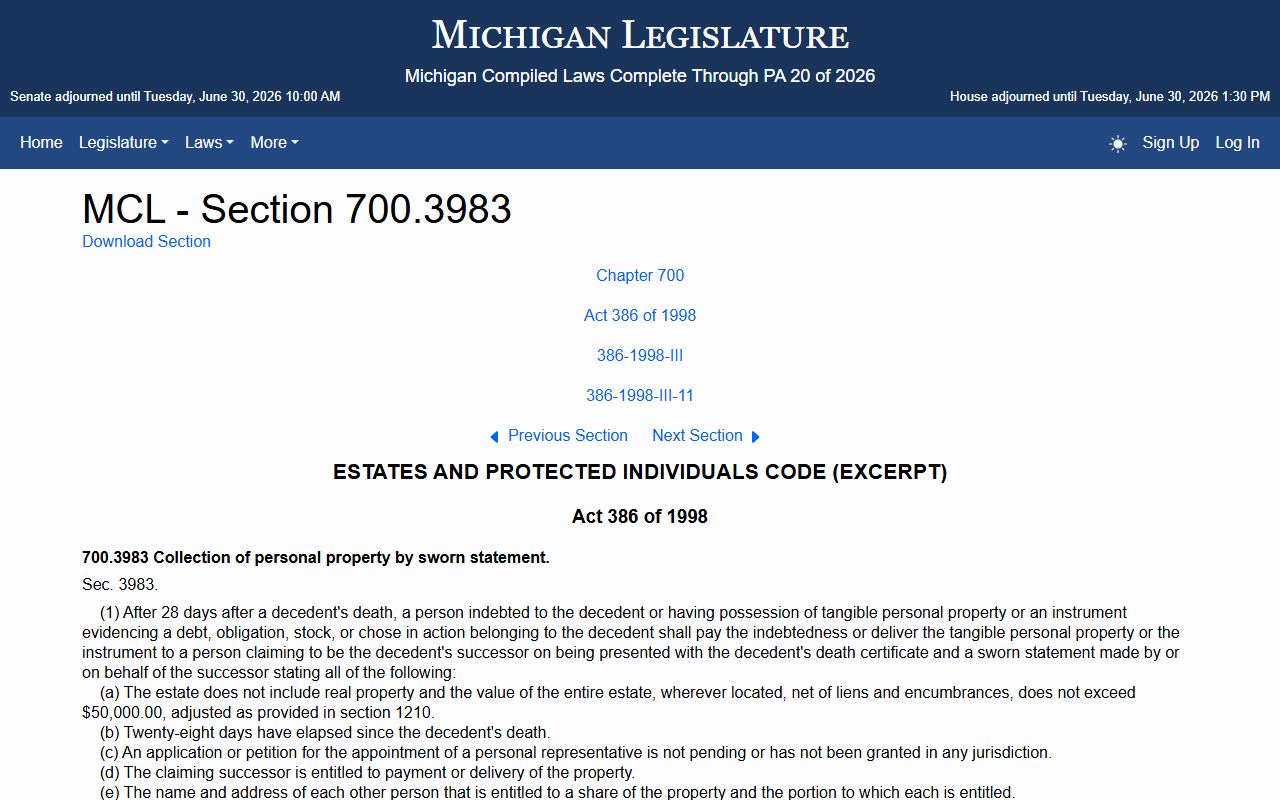
Under this section, an affidavit can move things like a bank account or a paycheck to the right person without opening a case. It works only when the estate qualifies and the statutory requirements are met. When property or debts run larger, or when heirs disagree, the full probate route with the Mason County court is the correct one instead.
Note: Small-estate thresholds adjust over time, so confirm the current limit with the Probate Court or the statute before choosing the affidavit or assignment path.
What Mason County Probate Records Show
A probate file grows as a case moves. It starts with a petition and, in an estate, the will if one exists. From there it collects the orders, inventories, and accountings that track how the estate or guardianship is handled. The register of actions lists each of these events in order, and the underlying documents fill in the detail.
Most public probate records include a common set of items. The list below covers what a searcher is likely to see on an open estate or guardianship case.
- The decedent, ward, or protected person named in the matter.
- The file number and the type of proceeding.
- Petitions, an admitted will, and letters of authority for the personal representative.
- Inventories that list estate assets and their values.
- Annual or final accountings showing money paid in and out.
- Court orders on distribution, guardianship, conservatorship, or treatment.
Letters of authority are worth a note. They are the court's proof that a personal representative or a guardian may act, and banks and other agencies often ask for a certified copy. The online register confirms that letters were issued, but the certified document itself comes from the court office.
Restricted Mason County Probate Records
Probate handles some of the most private matters a court sees, so not all of a file is open. Mental-health commitment and course-of-treatment cases carry strong confidentiality. Medical details, treatment plans, and related identifiers are shielded because Michigan and federal law bar their release. The public may learn that a proceeding exists without gaining access to the sensitive content inside it.
Guardianship and conservatorship files for minors and for protected adults can also hold restricted material. Financial disclosures, medical evaluations, and personal identifiers are common redaction targets. Developmental-disability matters fall under the same care. The MiCOURT tool simply does not display nonpublic information, and the county states plainly that certain data is not accessible online.
When a record is limited, the path forward is a direct request to the court, which can confirm what is public and what is sealed. A judge decides access questions for contested or protected files. For a broader look at how the county handles case files across its trial courts, the Mason County court records resources explain the same offices from the general records side.
Note: Mental-health and developmental-disability probate records are among the most protected court files in Michigan, and public access to their contents is sharply limited by law.
History of Mason County Probate Court
Probate is one of Michigan's oldest court functions. A court of probate was established in each organized Michigan county in 1818, nearly twenty years before Michigan became a state. Governors appointed the early judges. That changed in 1838, when state law made the office elective and gave voters a say in who ran the county's estate and guardianship docket.
Mason County adds its own chapter to that story. After the 1963 Michigan Constitution required judges to be lawyers, several sitting nonlawyer probate judges were allowed to remain in office until they retired. Judge Francis K. Bourisseau was one of them. He was one of the last nonattorney judges in Michigan, and the county describes him as the fourth longest-serving probate judge in the state. He served Mason County for 38 years, from 1957 until his retirement in 1995.
That long tenure spans a period when court records shifted from paper ledgers to electronic dockets. It explains why an older estate or guardianship file may look different from a modern one, and why the deepest historical records are more likely to live in the courthouse than in the online index.
Federal Estate and Bankruptcy Records
State probate and federal court are separate systems. Most estate work stays in the Mason County Probate Court, but a related debt or insolvency matter can land in federal court instead. Mason County sits in the U.S. Bankruptcy Court for the Western District of Michigan, and those cases never appear in MiCOURT. Federal records run through PACER and CM/ECF rather than the county tool. The court's registration and access details appear on the PACER lookup page for the Michigan Western Bankruptcy Court.
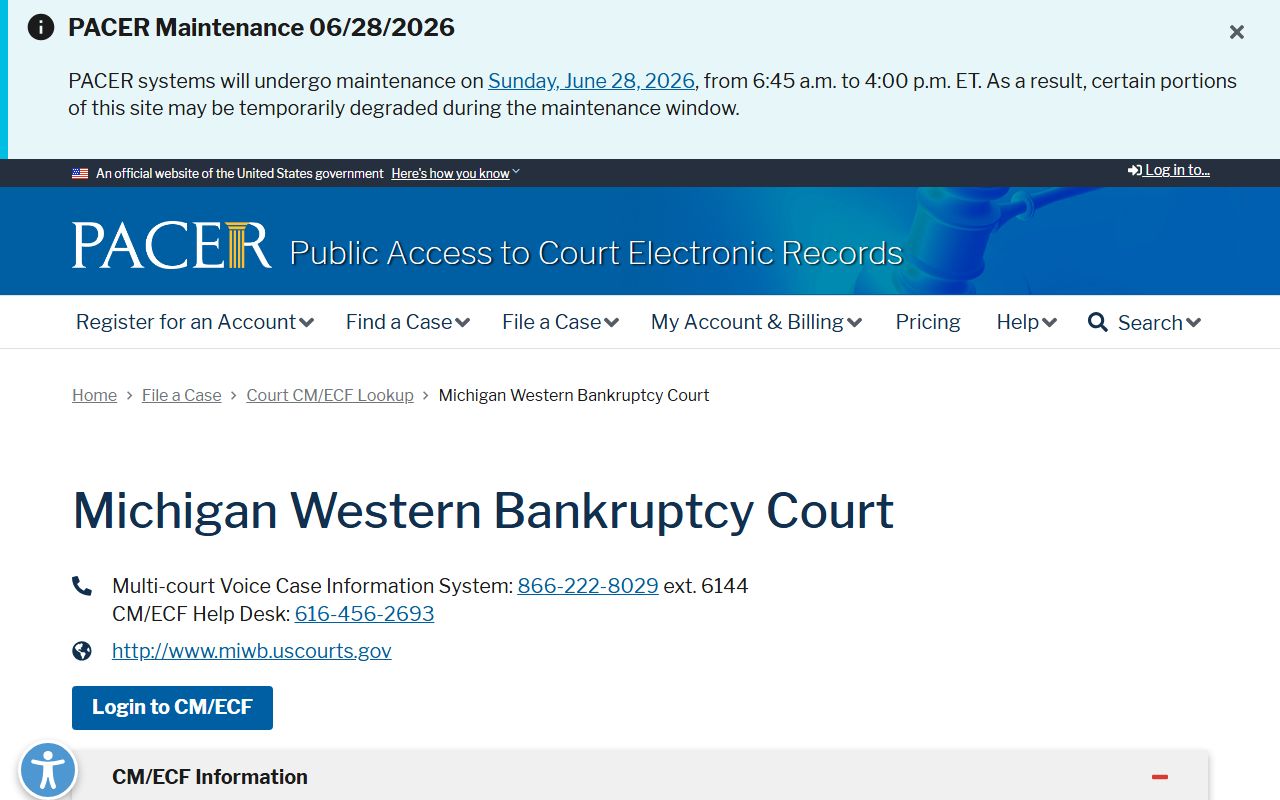
PACER is the federal counterpart to MiCOURT, and it charges per page rather than running free. A searcher who cannot find an estate-related debt case in the county system may need this federal route instead. For probate itself, though, the Mason County court and its statewide search route remain the correct starting point for wills, estates, guardianships, and conservatorships.