
Criminal Court Records in Mason County
A criminal court record is the case file a court opens the moment charges are filed against a person. It is not a police blotter and not a jail log. It is the court's own file, and it grows with every event in the case. The file holds the charges as filed, the arraignment, any pleas, motions from both sides, hearing dates, the verdict or plea, the disposition, and the sentence. For felony cases that finish in circuit court, the Mason County Clerk keeps these files. Clerk Cheryl Kelly's office maintains criminal, civil, domestic, and protection files for the 51st Circuit Court, accepts filings, and issues certified copies of documents in those cases.
Two local trial courts produce criminal records in Mason County. The 79th District Court, led by Hon. John D. Middlebrook with Attorney Magistrate Glenn Jackson III, handles misdemeanor cases start to finish and runs the early steps of every felony, including arraignment and the preliminary examination. The 51st Circuit Court, led by Hon. Susan Kasley Sniegowski, is the felony trial court. A felony moves up to circuit court only after a district judge binds it over. The charges themselves are covered in more depth on the Mason County arrest records and court charges page, and the wider filing set sits with the county's court records.
How to Search Mason County Criminal Court Records
Mason County does not run a local criminal case database. Public searching goes through MiCOURT Case Search, the statewide system built by the Michigan judiciary. Each court links a direct route. Felony and sentenced files open through the 51st Circuit Court route (C51~2). Misdemeanor cases and felony first steps open through the 79th District Court route (D79~2). Both pull from the same One Court of Justice case data, so the right route depends on where the case sits.
- Open the court-specific MiCOURT route, choosing the 51st Circuit for felonies or the 79th District for misdemeanors and early felony steps.
- Read the terms of service and clear the "I'm not a robot" image challenge until the green arrow appears, then click Continue.
- Enter the defendant's name or a file number, then click Submit.
- Open the case to read the register of actions, the running list of every charge, hearing, plea, and order.
- Ask the clerk or court that holds the file for a certified copy when you need one for legal use.
Statewide criminal history is a separate search. MiCOURT shows the case file for a single court, not a full rap sheet across every county. For prison, parole, and probation status, the Michigan Department of Corrections runs its own offender lookup, and county custody questions route to the Sheriff. County jail custody and active bench warrants sit in separate systems from the court case file.
Who Files Mason County Criminal Charges
Police make arrests, but they do not file charges. That job belongs to the Prosecuting Attorney, the chief law enforcement official for the county. Beth M. Hand holds the office, elected in 2024 after serving as an assistant prosecutor from 1992. Her office reviews reports from police agencies, decides what to charge, and then represents the People of Michigan in each case. The prosecutor is independent of the Michigan Attorney General and carries more than 250 statutory duties. Because the charge in the record starts as a prosecutor's decision, the office sits at the center of every criminal file the courts open.
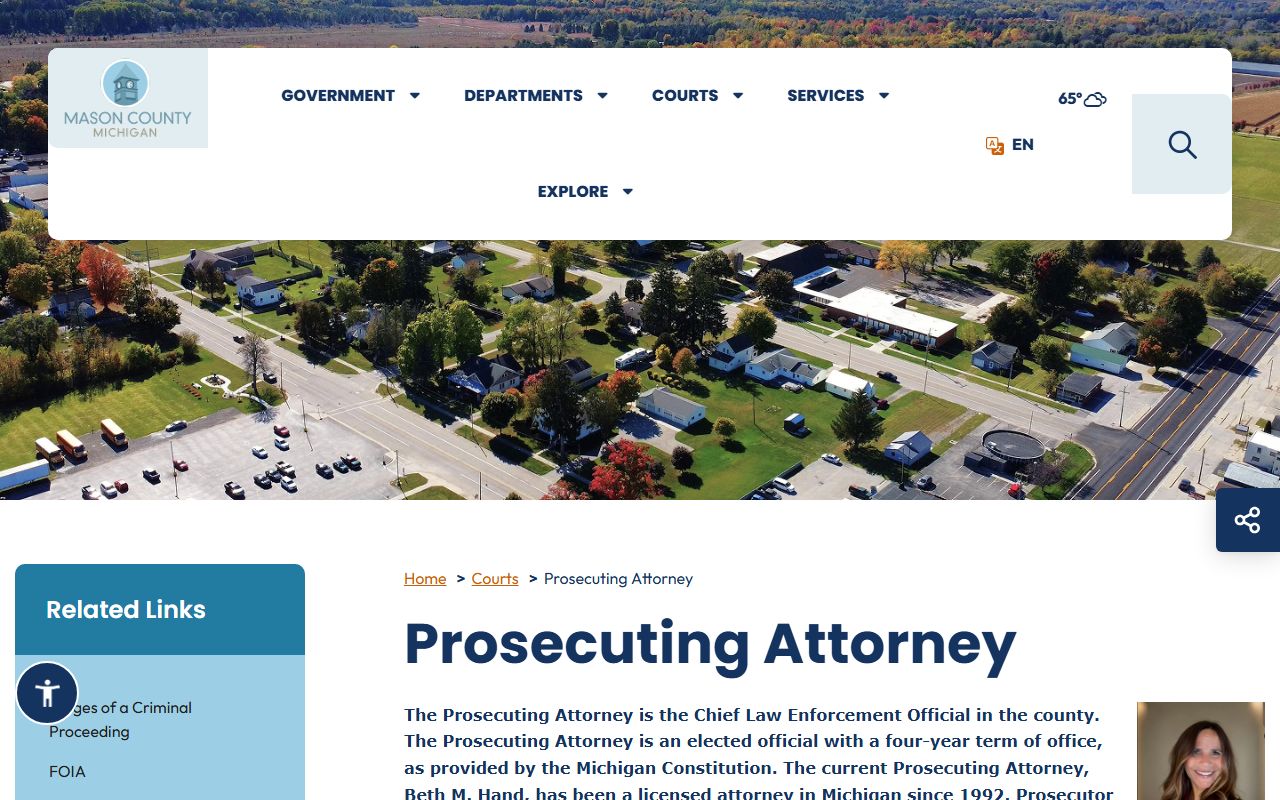
The county's Prosecuting Attorney page names Beth M. Hand and lays out her charging role across the District, Circuit, and Family Division courts. The image below shows that office page.
The prosecutor's decision shapes how a case reads later. A charge can be filed, amended, reduced, or dropped, and each move shows up in the file. The office prosecutes both adult and juvenile matters, files and answers appeals, and appears at contested mental-health commitment hearings. The prosecutor works from the Mason County Courthouse and can be reached at 231-845-7377. Knowing that charges begin here explains why a record often lists the People of Michigan as the party against the named defendant.
Stages of a Mason County Criminal Case
A criminal case moves through set stages, and each one leaves a mark in the record. A misdemeanor may run its full course in the 79th District Court. A felony starts in district court for the early steps, then crosses to the 51st Circuit Court once a judge binds it over. The register of actions logs the stages in order, so the file reads almost like a timeline from the first charge to the last order.
Case flow: Charges Filed › District Court Arraignment › Probable Cause Conference › Preliminary Exam › Bindover to Circuit Court › Circuit Arraignment › Pretrial › Plea or Trial › Sentencing
The county prosecutor publishes flow charts for misdemeanor, felony, and juvenile proceedings. Its criminal proceedings page links each chart, and the screen below shows where those maps of the process begin.
The stages below are the ones that matter most when reading a criminal court record. Not every case reaches trial. Most end in a plea, and the file still records each step the case passed through on the way to disposition.
| Stage | What Happens |
|---|---|
| Arraignment | The defendant's first court appearance, where the charges and legal rights are read and a plea can be entered. |
| Probable Cause Conference | A felony step in district court where the sides discuss the case before a preliminary exam is set. |
| Preliminary Exam | A district court hearing that decides whether a felony has enough proof to move up to circuit court. |
| Pretrial / Motions | Written requests, plea talks, and hearings that shape the case before trial. |
| Plea or Trial | The defendant pleads, or a judge or jury reaches a verdict. |
| Sentencing | After a conviction, the judge orders the sentence and any fines, costs, restitution, or probation. |
What a Mason County Criminal Court Record Shows
Open a criminal file and the fields line up in a familiar pattern. Michigan defines a court record broadly under Michigan Court Rule 1.109, which treats it as recorded information created by or filed with the court. On MiCOURT, clicking a file number opens the register of actions, and the fields below carry the core of the case.
| Field | What It Shows |
|---|---|
| Case Number | The court's ID for the case, clickable in results to open the full history. |
| Court | Whether the file sits in the 51st Circuit or the 79th District Court. |
| Defendant | The person charged, listed against the People of Michigan. |
| Charges | The offenses as filed, each with its own code and severity level. |
| Plea | The defendant's formal answer to each charge, such as guilty, not guilty, or no contest. |
| Register of Actions | The dated list of every filing, hearing, motion, and order. |
| Disposition | The final outcome of each charge, from conviction to dismissal. |
| Sentence | The punishment ordered, plus fines, costs, restitution, and probation terms. |
| Nonpublic Fields | Data withheld because state or federal law bars its disclosure. |
Some terms in a criminal file carry exact meanings. A short glossary helps the fields read clearly.
- Information
- The felony charging document filed in circuit court after bindover.
- Bindover
- The transfer of a felony from the 79th District up to the 51st Circuit Court.
- Disposition
- The final outcome of a case or a single charge.
- Restitution
- Money the court orders a defendant to repay a victim.
- Register of actions
- The chronological event list for one case.
Public MiCOURT data often shows register-of-actions entries rather than scanned documents. The county also warns that the online view is not the official record. For a filed document or a certified copy, the request goes to the clerk or court that holds the file.
Charges vs. Convictions
Being charged is not the same as being convicted. A criminal court record can list charges that were later dropped, dismissed, or ended in an acquittal. A charge is an accusation. A conviction is the finding of guilt that comes from a plea or a verdict. Reading a file the right way means checking the disposition for each charge, not just the charge line at the top.
| Charge | Conviction | |
|---|---|---|
| Stage | Accusation as filed | Guilty verdict or plea |
| Burden of Proof | Probable cause | Beyond a reasonable doubt |
| Can Change | Amended, reduced, or dropped | Stands unless appealed or set aside |
| Public Record | Yes | Yes |
The gap between the two fields matters for anyone reading a record. A file with three charges may end with one conviction and two dismissals. The disposition field settles the question. When only a charge shows and no disposition appears, the case may still be open and moving through the stages above.
Reading Dispositions and Sentences
The disposition is the outcome, and it is the field most searchers care about. Common entries include guilty, not guilty, dismissed, and no contest, where the defendant accepts the penalty without admitting guilt. Some cases show a deferred outcome, where a plea is held back while the defendant meets set terms. Once a conviction lands, the sentence follows in the same file. A Michigan sentence can mix jail or prison time, probation, fines, court costs, and restitution paid to a victim.
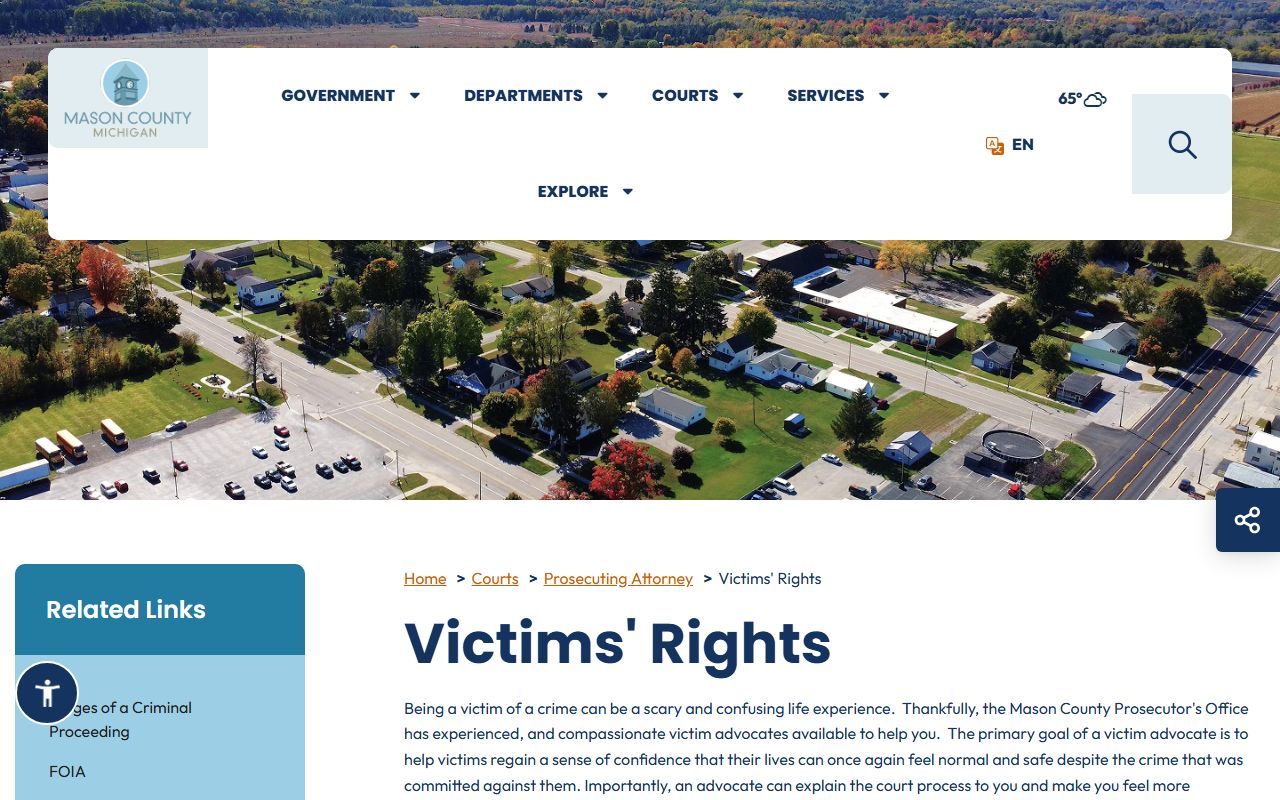
Victims have a formal place in the process, and the prosecutor's office helps them through it. Its victims' rights page explains how advocates guide victims and lists the office contact details. The page below shows that resource.
Restitution ties the record back to the victim named in the case. When a judge orders it, the amount appears in the financial section of the file, alongside fines and costs. A victim advocate can explain how a restitution order is entered and collected. For records users, the sentence and its financial terms are the clearest sign that a case reached a conviction rather than a dismissal.
Sealed vs. Set-Aside Records
Michigan uses the term "set aside" for what many states call expungement. Sealing hides a record from public view while it still exists in limited form. A set-aside goes further and makes the public conviction record nonpublic, subject to statutory exceptions. The two are not the same, and the difference decides what a public search will still show. An eligible person applies in the court where the conviction happened, using the state-approved form for that type of case.
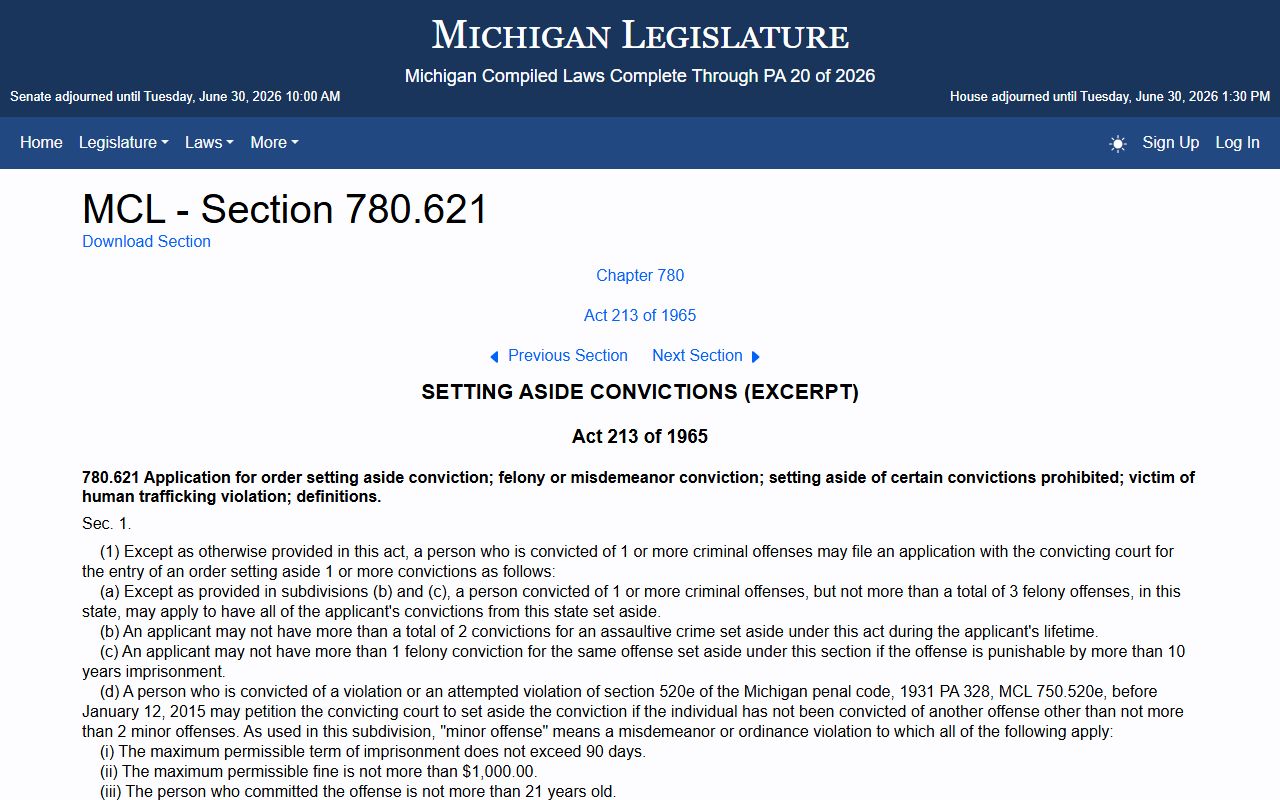
The main application process lives in statute. The set-aside law, MCL 780.621, sets out who can apply and how, and the page below shows that statute.
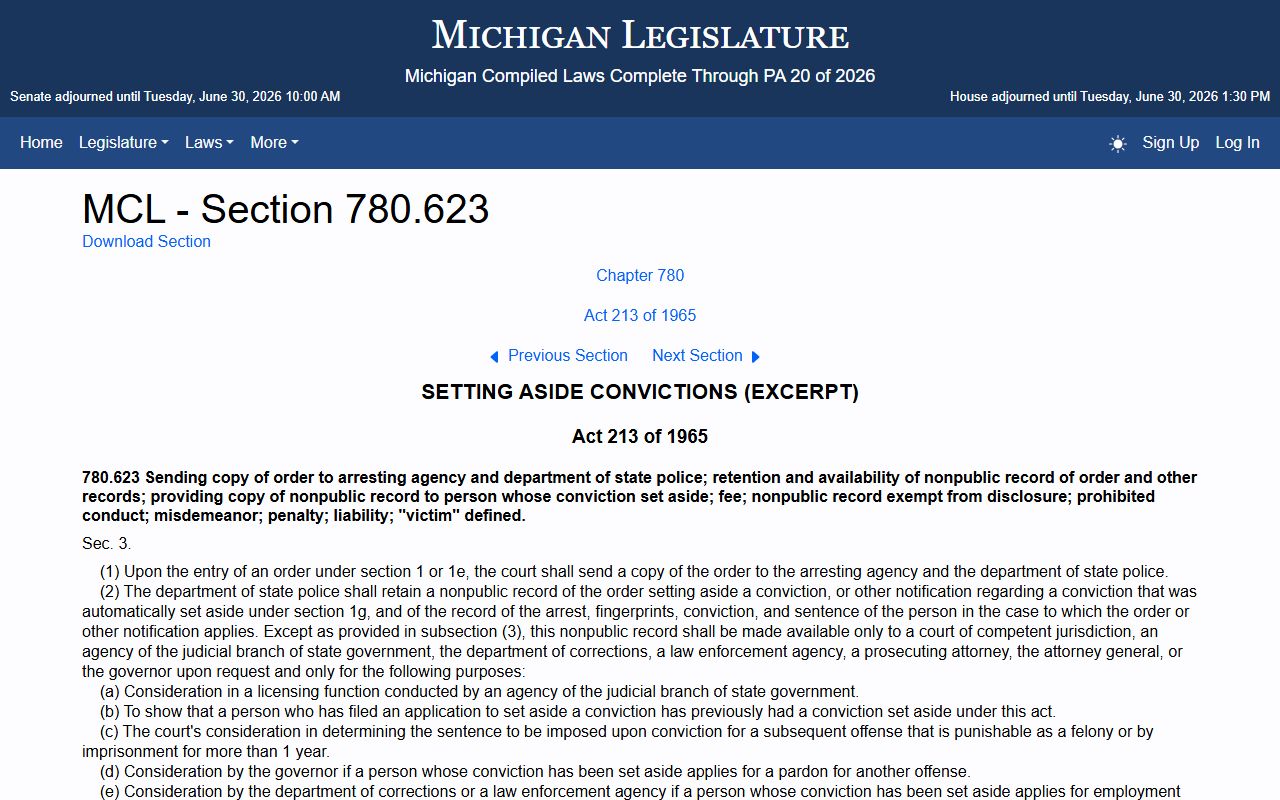
What happens after a court grants the request is governed by its own law. The effect-of-set-aside law, MCL 780.623, explains how the record is handled once the order is signed, including the nonpublic treatment of the conviction. The image below shows that statute page.
For a Mason County conviction, the venue depends on where the case ended. A misdemeanor disposed in the 79th District Court is set aside in that court. A felony bound over to the 51st Circuit Court is set aside in circuit court. The court checks eligibility, notices the prosecutor and law enforcement, and may hold a hearing. A granted order does not erase every government file, but it does change what MiCOURT and clerk searches display.
| Sealed | Set-Aside | |
|---|---|---|
| Visibility | Hidden from public view | Conviction made nonpublic by order |
| Record Exists | Yes, with limited access | Yes, but treated as nonpublic |
| Law Enforcement | Limited access | Retained for statutory exceptions |
| Michigan Term | Sealing or nonpublic file | Set aside under MCL 780.621 |
Public Access to Mason County Criminal Records
Michigan treats criminal case files as public by default, with exceptions written into law. Access runs mainly through court rules rather than a broad records request. Circuit criminal files are kept by the County Clerk's court-services office, while district criminal cases are reached through the 79th District Court and its MiCOURT route. The clerk can search files and issue certified copies, but staff cannot give legal advice.
Key Statutes:
Michigan Court Rules, MCR 8.119 - governs how trial courts maintain records and how the public may inspect them.
Michigan Freedom of Information Act, MCL 15.231 - covers records of public bodies, though most case files are reached through the clerk instead.
The practical rule is short. Start with the court or clerk that holds the case, not with a general FOIA letter. County administrative records go to the FOIA officer, while Sheriff and Prosecutor records run through their own separate channels. MiCOURT stays a public tool, yet the county warns it does not replace the official record and that nonpublic data is withheld.
Background Check Considerations
A casual name search is not a background check. Employers, landlords, and licensing bodies that make decisions from criminal records must follow the federal Fair Credit Reporting Act, which sets rules for accuracy, notice, and dispute rights. A quick MiCOURT lookup shows one court's file, not a verified statewide history. For a decision that affects someone's job or housing, a compliant screening firm or a certified record from the court is the safer path.
Important: This site is not a consumer reporting agency under the Fair Credit Reporting Act, and its records cannot be used for employment, housing, credit, or other FCRA-regulated decisions.
Restricted Mason County Criminal Records
Not every criminal record is open. Juvenile cases are among the most protected. The juvenile records law, MCL 712A.28, limits who may inspect many juvenile court files, so public access should not be assumed even when a court has jurisdiction. Set-aside convictions are made nonpublic once a court grants the order. Sensitive personal identifiers are withheld under state and federal law, and MiCOURT does not display data the county marks as nonpublic.
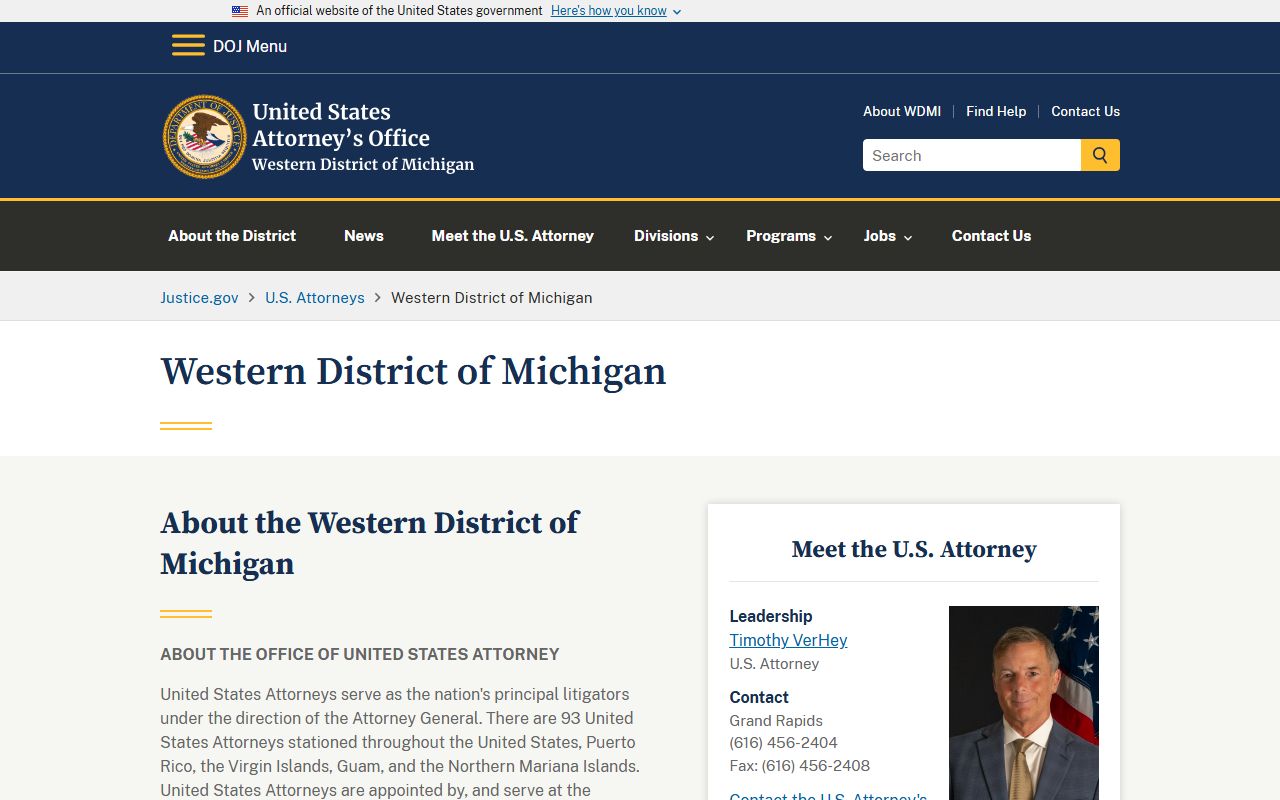
Some Mason County matters never appear in the county file at all. Serious federal crimes are charged in the U.S. District Court for the Western District of Michigan, and the U.S. Attorney's Office prosecutes them. The page below shows that federal office.
Federal criminal files live in the federal PACER system, not in MiCOURT. A search that comes up empty in the county routes may mean the case was charged federally, sits in a sealed status, or simply predates the digital record. When a public search stops short, the clerk or court that holds the paper file is the next stop.
Note: Michigan and federal law bar disclosure of some case data, so a public criminal record can appear less complete than the official file the court keeps.